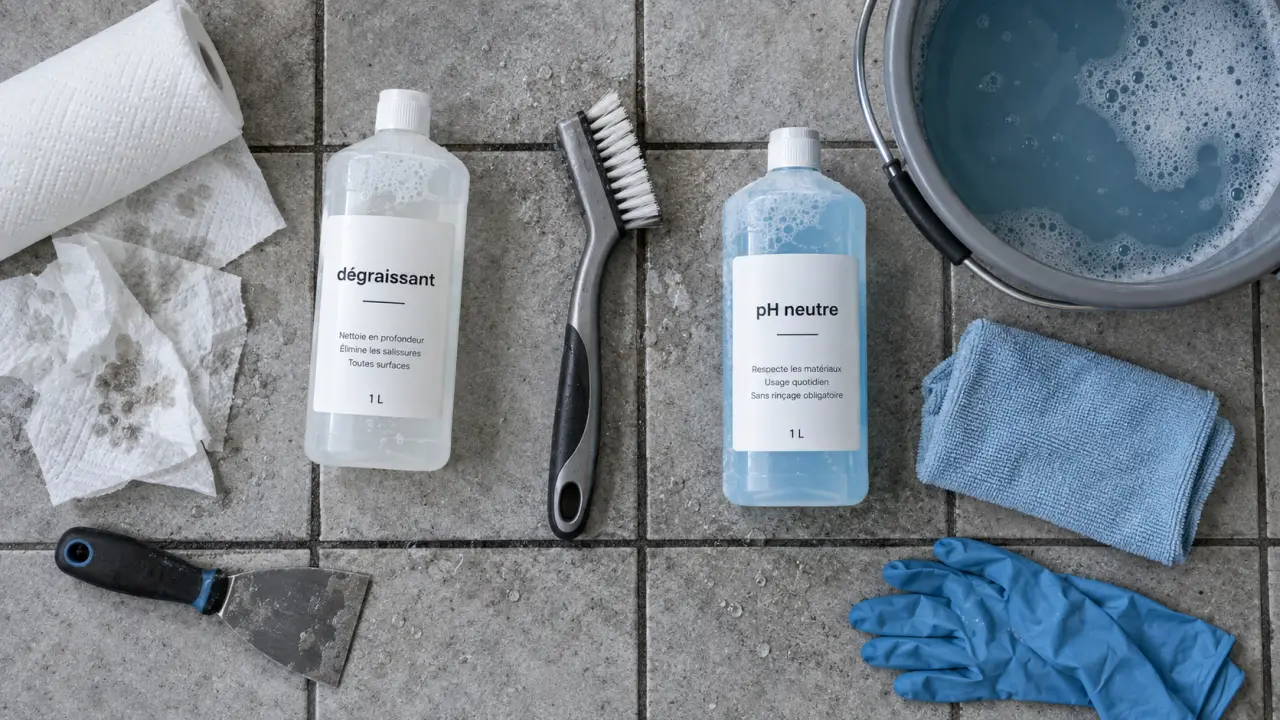
Choosing tile cleaners is less about finding the strongest bottle and more about matching the formula to the surface and the soil. A kitchen floor with greasy grout, a shower with soap residue, and a natural-stone entryway need different treatments. The right combination of cleaner, brush, rinsing, and protection can restore the floor without damaging its finish.
Start with the tile, grout, and type of dirt
Before buying a tile floor cleaner, identify what is actually on the surface. Ceramic and porcelain tiles are generally more tolerant than natural stone, while grout lines can hold dirt below the visible surface. Grout is porous, so spills, grime, and discolouration can remain even when the tile itself looks clean after mopping.
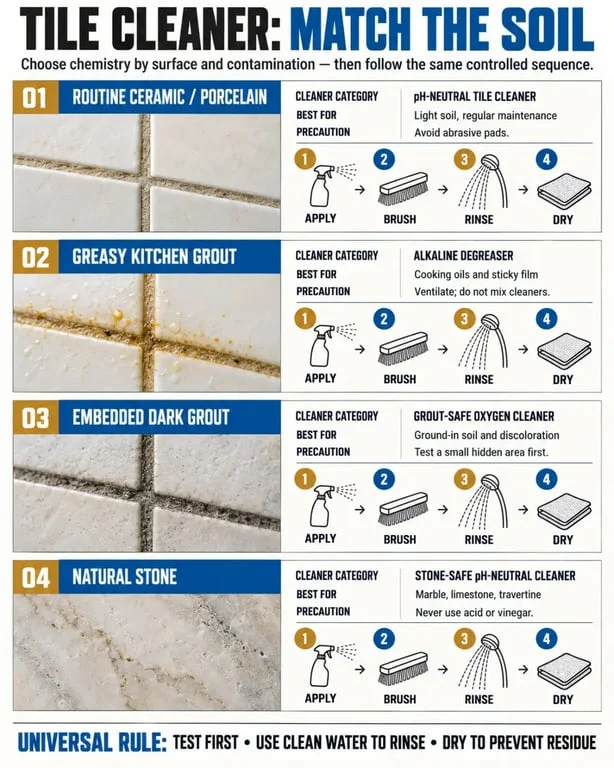
| Cleaning situation | Suitable cleaner type | Key precaution |
|---|---|---|
| Routine dust and light marks | Neutral everyday tile cleaner | Use a low-residue formula and rinse if directed. |
| Kitchen grease and heavy soil | Hard-surface degreaser | Test first and do not let a strong product dry on the surface. |
| Dark or stained grout | Tile and grout prespray plus grout brush | Agitate gently, as excessive abrasion can wear grout. |
| Natural stone | Natural-stone-safe, pH-neutral cleaner | Avoid acidic or highly alkaline products unless the stone supplier approves them. |
| Grout haze, old finish, or sealer residue | Purpose-made stripping agent | Confirm compatibility and provide good ventilation. |
Why regular mopping often leaves grout looking dirty
A mop can remove loose soil from the tile face, but it may also move dirty water across recessed grout lines. Once soil settles into porous grout, a quick pass with a household cleaner rarely reaches it. The result is a floor that appears clean from a distance but still has dark joints, a sticky feel, or dull-looking edges.
Use the cleaning sequence, not just more product
For embedded dirt, follow a practical sequence: vacuum or sweep first, apply the chosen cleaner according to its label, allow the stated contact time, agitate with a suitable brush, then remove the dirty solution and rinse. A grout brush is more effective than scrubbing the entire tile with an abrasive pad. Always test a discreet area, especially near coloured grout, decorative tiles, polished surfaces, and transitions to wood or vinyl.
Cleaning works as a sequence. Application loosens the soil, brushing breaks its grip, and rinsing carries it away. If the final step is skipped, loosened grime and chemical residue can settle back into the joints. Controlled water use and thorough removal matter as much as the cleaner itself, particularly on textured tile where residue can affect appearance and traction.
When stronger professional tile cleaning products make sense
Commercial tile cleaning products are useful when the problem is specific and stubborn: cooking grease, tracked-in grime, post-renovation dust, mortar smears, grout residue, or failing topical finishes. They are not automatically better for every floor. A powerful 14 pH hard-surface degreaser, for example, is designed for heavy-duty degreasing and requires careful surface checks, correct dilution where specified, protective gloves, and a complete rinse.
Tools that improve results without increasing risk
A stiff nylon grout brush, a soft mop or microfiber pad, wet-dry extraction equipment, and clean rinse water can make a major difference. Cleaning professionals may use a prespray, mechanical agitation, and hot water extraction to lift contaminated solution from tile and grout. This approach is particularly useful when manual scrubbing has become messy, uncomfortable, or ineffective.
- Choose a prespray for deep-set grout soil.
- Choose a degreaser for kitchen or job-site oils.
- Choose a stripping product only for confirmed finish or sealer removal.
- Choose a sealer or surface protector after the floor is fully clean and dry.
Protect natural stone and recently installed tile
Stone requires special care because some materials are sensitive to acids, alkalis, and solvents. Do not assume that a cleaner labelled for “tile” is safe for marble, limestone, travertine, or other natural stone. Use a stone-safe everyday cleaner and follow the tile, grout, or stone manufacturer’s maintenance advice when available.
On a job site, preparation also matters. Remove dust, grease, and loose debris before installation, repair, sealing, or colour matching. For grout haze and mortar smears, select a product designed for the residue and the tile type. An aggressive stripping agent can create more damage than the original mark if it is used on an incompatible finish.
Decide between DIY cleaning and a professional service
A do-it-yourself approach is usually appropriate for routine maintenance, isolated spills, and light grout discolouration. Consider a professional tile and grout cleaning service when large areas remain dull after careful cleaning, grout is deeply soiled, or the floor needs extraction equipment and a controlled chemical process. Professional hot water extraction is intended to remove hidden dirt from grout rather than simply brighten the tile surface.
After a deep clean, keep the result longer by sweeping often, wiping spills promptly, using a compatible cleaner, and avoiding residue-heavy products. Where appropriate for the material, sealing clean and dry grout can improve resistance to future stains. The best tile cleaners are part of a complete system: correct diagnosis, compatible chemistry, gentle agitation, complete rinsing, and regular maintenance.
{“@type”:”Article”,”@context”:”https://schema.org”,”headline”:”The Right Tile Cleaner Restores Grout, While the Wrong Formula Dulls Stone”,”inLanguage”:”en-US”,”description”:”Choosing tile cleaners is less about finding the strongest bottle and more about matching the formula to the surface and the soil. A kitchen floor with greasy grout, a shower with…”}
Use the safest cleaning method first
Cleaning works best when you start with the least aggressive method that can solve the problem. Test products on a small hidden area, read the label, and give the cleaner enough contact time before scrubbing harder. Many stains become worse when heat, bleach or the wrong acid is used too early.
Never mix cleaning products unless the label clearly says it is safe. Bleach, ammonia, vinegar, peroxide and descaling products can react badly in the wrong combination. When in doubt, rinse the surface, ventilate the room and switch to a simpler method before trying another chemical.
Related guides to continue
To build a stronger understanding of this topic, continue with these related guides from the same site. They cover nearby decisions, maintenance points and practical details that often influence the final result.